Call Us:
Sales:
(712) 430-0814
Open Today Sales: 8:30 AM-7 PM


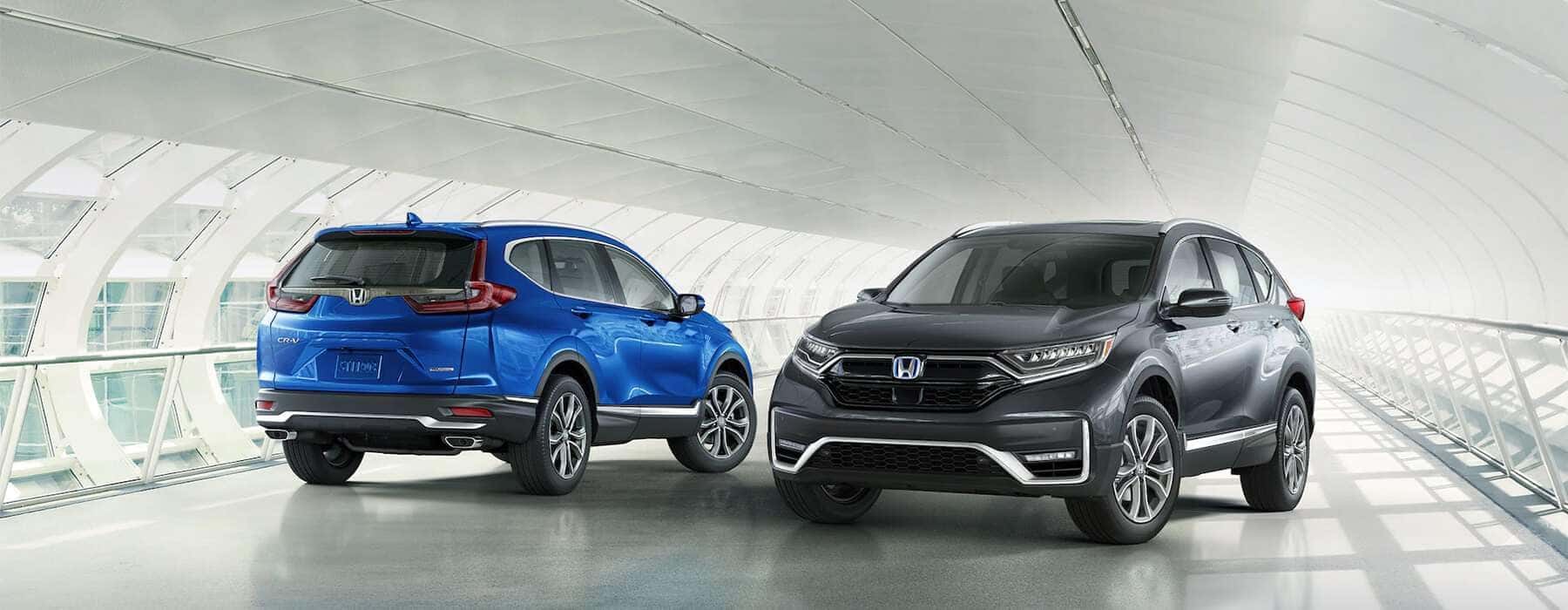
As your dedicated Honda CR-V dealer in Sioux City, Iowa, our staff wanted to answer some of the most frequently asked questions about this best-selling crossover SUV. Join Vern Eide Honda Sioux City for a question and answer session all about CR-V. We’ll provide information about past and present CR-V models, CR-V trims, CR-V pricing, and much more.
No, the Honda CR-V will not be redesigned in 2021. CR-V was just restyled for the 2020 model year.
There are eight CR-V colors available for the 2021 model year, including Sonic Gray Pearl, Aegean Blue Metallic, Crystal Black Pearl, Lunar Silver Metallic, Modern Steel Metallic, Obsidian Blue Pearl, Platinum White Pearl, and Radiant Red Metallic. Click here to see an overview of the 2021 Honda CR-V.
The 2021 Honda CR-V LX base model with 2WD has a starting price of $25,350 (MSRP)*, while last season’s 2020 CR-V LX with 2WD has a starting price of $25,150 (MSRP)*. Click here to see new Honda CR-V inventory.
The 2021 Honda CR-V lineup consists of four different trim levels, including the LX, EX, EX-L, and Touring. Each CR-V trim builds off the base LX model, upgrading the crossover’s features, amenities, exterior elements, and safety technologies. Click here to learn more about the different Honda CR-V trim levels.
No, the Honda CR-V EX does not have leather seats. This trim level comes with either a gray or black cloth interior. CR-V EX-L and Touring models, however, are outfitted with leather seating.
The difference between the Honda CR-V EX and CR-V Touring can be seen in both appearance and their feature sets. CR-V’s Touring model builds on the EX trim by adding roof rails, 19-inch alloy wheels, LED headlights with auto on/off, dual chrome exhaust finishers, and ambient lighting inside the cabin. The 2021 CR-V Touring also upgrades its feature set to include the following:
There is plenty of speculation as to what CR-V stands for. Many auto enthusiasts believe it’s simply an abbreviated version of the word “crossover.” However, according to Kelley Blue Book, others have claimed CR-V stands for either compact recreation vehicle or comfortable runabout vehicle.
When comparing the Honda CR-V EX and CR-V LX, it’s not a matter of which model is “better.” Both trim levels come with the same powertrain, horsepower, gas mileage, and overall styling. However, the CR-V EX builds on the LX feature set with more amenities and Honda Sensing® technology like the Blind Spot Information (BSI) System, dual-zone automatic climate control, heated front seats, Apple CarPlay® and Android Auto™, power moonroof, remote engine start, Smart Entry with Walk Away Auto Lock®, and more.
Yes, Honda is coming out with a hybrid CR-V. In fact, this hybrid crossover made its debut last season in 2020. Click here to browse new Honda CR-V Hybrid inventory. Click here to see new Honda CR-V Hybrid inventory.
The difference between CR-V and CR-V Hybrid lies in the powertrain. While all 2021 Honda CR-V trims are equipped with an in-line 4-cylinder with turbocharger, 2021 CR-V Hybrid models are powered by a combination of an AC Synchronous Permanent-Magnet Electric Motor, lithium-ion battery, and in-line 4-cylinder engine. Additionally, all 2021 CR-V Hybrids come standard equipped with all-wheel drive (AWD).
How much the CR-V Hybrid costs will depend on which trim level you select. However, the 2021 CR-V Hybrid EX base model has a starting price of $30,560 MSRP*.
If you appreciate the original Honda CR-V, value fuel economy, and don’t wish to sacrifice horsepower, the Honda CR-V Hybrid is worth it. The 2021 CR-V Hybrid makes 212 total system horsepower and achieves fuel economy ratings of 40 city / 35 highway / 38 combined mpg.*
No, the Honda CR-V Hybrid does not need to be plugged in since its power is derived from a gasoline engine / electric motor combination.
The Honda CR-V Hybrid pairs a 2.0-liter, DOHC i-VTEC® Atkinson-cycle engine with an electric motor and e-CVT transmission. CR-V’s hybrid powertrain features three driving modes, including ECON, Sport, and EV to customize your efficiency and the Hybrid Driver Information Interface allows you to how the vehicle is being powered and battery status.
Currently, according to FuelEconomy.gov, only all-electric and plug-in hybrid cars purchased new in or after 2010 may be eligible for a federal income tax credit.
